

Words Mean Things: Getting Back to Basics with Keyword Research
Let’s take the overwhelm out of SEO and keywords.
If you’re just a beginner at keyword research then this is for you. Finding keywords (or search terms) your audience are using doesn’t have to be overly complex, especially when you’re learning.
You’ll find an easy way to find the right words to use in your own content that will connect with your audience, without the overwhelm.
READ MORE
I think there can be a lot of misinformation or misunderstanding around keywords. The bro-ification of SEO has a lot to do with it. The less than ethical practices (known as black hat SEO) have made keywords almost a bad word.
Creatives can think it’s overly technical (it can be, but not always! So please don’t be put off).
Many small businesses bypass SEO as they think they can’t rank organically on Google (you absolutely can rank on Google!).
Keywords (and SEO more generally) can seem overwhelming. There’s so much info out there, it’s difficult to know where to start
Ultimately though, keywords are what can connect you with your right audience. The people actively looking for your products, services, and content. Keywords are about communication. Distilling information into a few, well, keywords.
Keywords are about knowing your audience and how they search.
GETTING KEYWORDS RIGHT
I once saw a comment that said we know our businesses better than anyone else and we should use those descriptive words as keywords. To an extent I agree, but I also think that isn’t quite right either.
Sometimes we get too close to our own business, the jargon, the specialist language. Our audience and customers just don’t use the same language as us (sometimes).
The Curse of Knowledge
This is also known as ‘Curse of Knowledge’ (read more about it here).
We can fall into the mistake of thinking other people have the same knowledge as us.
This can lead us to using the wrong kind of keywords in our communications (website, social media and so on).
Unfortunately, this can either lead us to not being discovered or putting our audience off.
Words are important, keywords are vital.

TAKING THE SIMPLE APPROACH TO KEYWORDS
Luckily, finding the right keywords is a relatively straightforward thing to do. There are endless apps and software to help us. But, I find, some of the easiest ways to do keyword research is to go to search engines and begin exploring words on those. (I’m including Pinterest in this btw, it is a search engine, not another social media platform).
A QUICK LOOK AT KEYWORD RESEARCH BASICS
Keyword research can be done easily or with great complexity. Both often have the same results. So, let’s look at a couple of easy ways to do keyword research than can have a positive impact on your business.
We can fall into the mistake of thinking other people have the same knowledge as us.
USING GOOGLE SEARCH TO FIND KEYWORDS
Let’s pretend I’m planning a wedding. I have limited budget and looking for ideas. I’m at the start of my planning, not ready to purchase anything yet. My two main sources of inspiration will be Google and Pinterest. I start to type ‘wedding ideas’ into Google and Google begins auto-populating:
(*a quick note on Google search and Pinterest too: the algorithm that brings up the results relies on knowing your location, your search history, and so on. So, these results will be tailored to you. If you want a more general search, use an incognito window. If you’re on Chrome, go to the top right and select the three little dots then new incognito window, other browsers will have a similar function).

The above searches are the most popular searches for those words. I have now clicked on ‘wedding ideas on a budget’, Google suggests this:
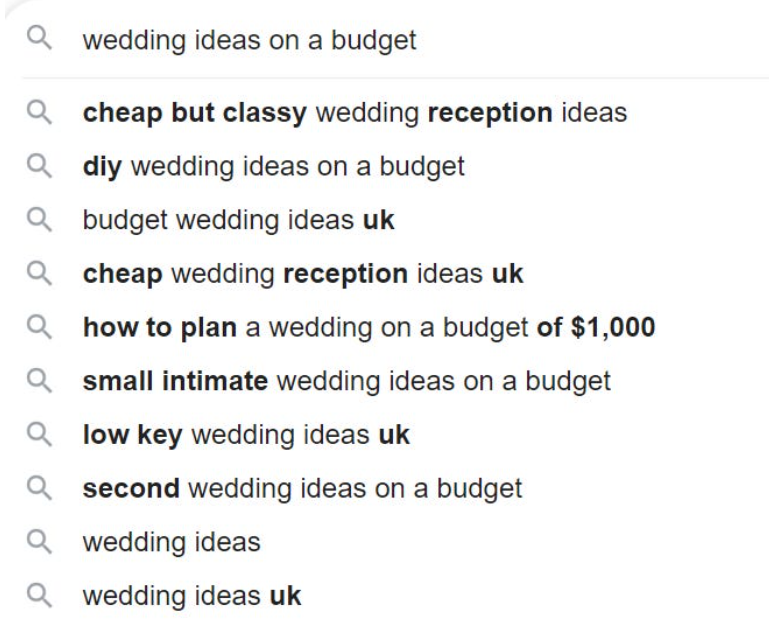
And also ‘related searches’ (this is often at the bottom of the page):

All of these results can be used for keywords and they’re a great way to get your content ranking on Google. You can keep clicking on the suggested searches and explore more keyword ideas.
The important thing to remember is to only use the relevant keywords to your business, its content, and services. We want the right people to come to our websites, not just traffic for the sake of it (unless you’re a blogger looking for ad revenue).
For a walk-through on how to do keyword research on Pinterest see this post here.
KEEPING KEYWORD RESEARCH SIMPLE
You can of course use things like search volume to make sure you aren’t going for keywords that might be too competitive for your website currently. If you are starting to build traffic to your site, it’s good to go for low volume keywords and use long tail keywords. This just means searches that have low competition, so you have a greater chance of ranking.
Long tail is targeting keywords like ‘how to plan a wedding on a budget’ instead of ‘wedding’ or ‘wedding ideas’. Those shorter keywords are much harder to rank for, plus that’s now how we really search.
For more about low volume keyword research see this SEMrush article.

HOW TO USE KEYWORDS
When creating a new piece of content, a page about your new service or product always start with keyword research. This will give you a greater chance of getting found by your audience. Use those keywords in your main copy, headings, title, image file names, URL and so on. But remember to never ‘keyword stuff’, keep it organic and useful to your audience.
KEEP IN MIND SEARCH INTENT
When doing keyword research have a look at what Google is ranking high. Is it a piece of content giving ideas on weddings on a budget for example, or is it venues and other services? This is important as it will help you with ‘search intent’. Some searches are to help your audience in the beginning of their planning, and others are about buying your services. Noting what Google is ranking will help you tailor your content to the different stage your audience is at.
ALWAYS PUT YOUR AUDIENCE FIRST
Keeping your audience at the forefront of your mind when creating content and so on will always keep you right when it comes to keyword research, and pretty much anything to do with your business.
If you would like to dive deeper into Pinterest SEO and keywords, I have a short course, you can read more about it by clicking here.