
Ecommerce SEO: How to Get Your Products Found (and Chosen) in Search
Ecommerce SEO is one of the most sustainable ways to get your products in front of people who are actively looking to buy. Not scrolling. Not browsing aimlessly. Searching with intent.
It goes far beyond adding a few keywords to product pages. Ecommerce SEO combines understanding search behaviour, structuring your site properly, creating genuinely helpful content, and building trust at every stage of the customer journey.
Below, we’ll cover the foundations of ecommerce SEO so you can start increasing visibility, traffic, and sales.

Why You Need Ecommerce SEO For Your Business
Think of your website as a physical shop on a busy high street. You can spend a fortune on flashy window displays (ads) to grab the attention of people walking past, but as soon as you stop paying, the crowds disappear. Ecommerce SEO is different. It’s like moving your shop to the very corner where everyone is already standing with their wallets out, asking, “Where can I find exactly what you sell?”.
It’s about building a foundation that works for you 24/7, so you don’t have to relentlessly post on social media to make sales.
The real magic of SEO for small businesses is that it levels the playing field. You don’t need the million-pound marketing budget of a giant retailer to show up in search results. By focusing on being helpful, clear, and easy to find, you can earn your way to the top. It’s not just about getting more traffic; it’s about getting the right traffic – the kind that leads to loyal customers, fewer returns, and a brand that people naturally trust. Let’s start by looking at keywords i.e. the search terms your potential customers are using.
Keyword Research
for Ecommerce
Keyword research is about understanding how potential customers search for products like yours. Once you understand this, you can use those search terms strategically across product pages, category pages, blog content, and more.
For ecommerce, keywords generally fall into four main intent types.
NAVIGATIONAL
INFORMATIONAL
COMMERCIAL
TRANSACTIONAL
Navigational Keywords
These are searches where someone is trying to find a specific brand or website.
Examples include:
- “Toast clothing”
- “Nike UK”
- “Zara returns”
You usually already rank for these if people know your brand, but they are still important to monitor, especially as your brand grows.
Informational Keywords
These searches happen earlier in the buying journey. The user wants to learn or solve a problem.
Examples include:
- “How to grow herbs indoors”
- “How to create a cosy living room with lighting”
- “How to clean leather boots”
These keywords are perfect for blog posts, guides, FAQs, and evergreen content that introduces people to your brand before they are ready to buy.
More about content marketing later.
Commercial Keywords
This is where comparison and consideration happens.
Examples include:
- “Best headphones for travel”
- “Best non toxic candles”
- “Organic cotton bedding reviews”
These users are close to purchasing, but they want reassurance. Comparison content, buying guides, and category page optimisation work well here.
Transactional Keywords
These are the money keywords. The user is ready to buy.
Examples include:
- “Buy Sony WH headphones”
- “Order ceramic mixing bowls”
- “Organic cotton duvet cover UK”
Your product and category pages should be built around these terms.
A strong ecommerce SEO strategy maps all four intent types across your site, instead of focusing only on product pages.
Where to Find Keywords (Easily)
Here are some places to find keywords:
- Google & Pinterest’s autocomplete
- Pinterest autocomplete
- Google keyword planner
- Pinterest ads & Trends
- Customer reviews & questions
- Social media comments
- Keyword tools like Semrush, Keywords Everywhere, Answer the Public, and so on.
k e y w o r d s

Optimising On-Page SEO
for Ecommerce
For ecommerce sites, this means making sure every page clearly explains:
- what it’s about
- who it’s for
- why it’s useful
When on-page SEO is done well, pages are easier to understand, more relevant in search results, and more likely to convert visitors into customers.
Key elements to optimise for on-page SEO include:
- Title tags
- Meta descriptions
- Headings
- Product descriptions
- Image alt text
Let’s have a look at these a bit more closely below.
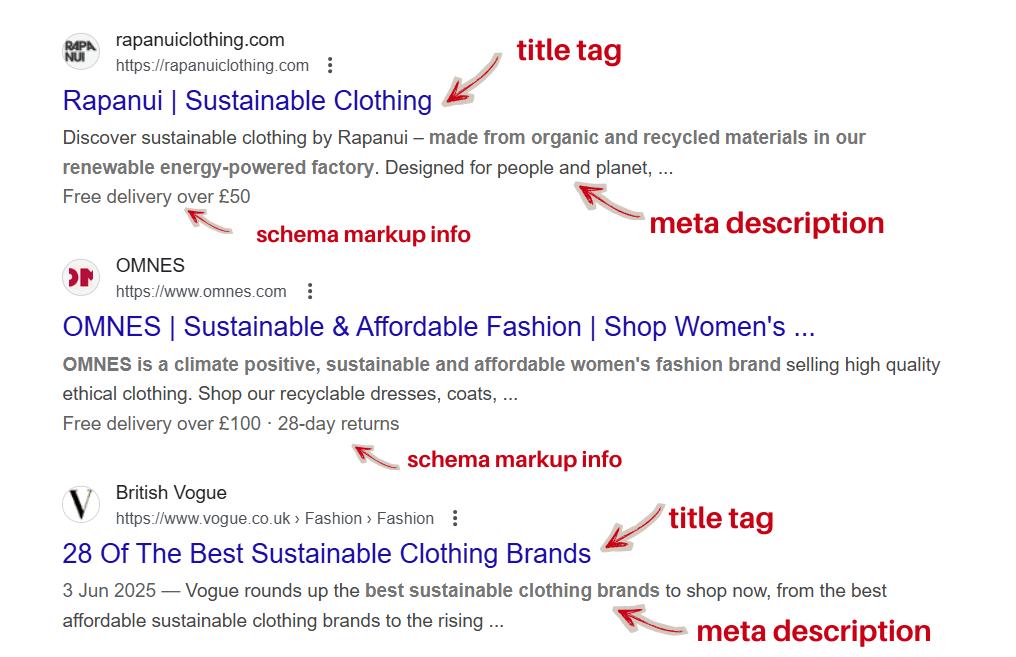
Title Tag Optimisation
These are your shop windows in search results.
A strong title tag should:
- Be short and descriptive
- Include the main keyword naturally
- Reflect the page intent
- Include a subtle CTA or incentive where appropriate
For example, this could include:
- “Free UK delivery”
- “Handmade in the UK”
- “Sustainable materials”
Avoid stuffing multiple keywords into one title. Clarity always wins.
Meta Descriptions
Meta descriptions do not directly affect rankings, but they strongly influence click-through rate.
A good meta description should:
- Be unique for each page
- Clearly describe what the page is about
- Include the main keyword
- Encourage action
Think of it as a mini sales pitch. You are answering the question, “Why should I click this result instead of the others?”
Product Images and Visual SEO
Images are essential for ecommerce, but they can also slow your site down if not handled properly.
Optimising product images includes:
- Using descriptive file names instead of camera defaults. For example: white-ceramic-plates, handmade-gold-ring.
- Adding clear, helpful alt text that describes what the image is
- Compressing images to reduce file size (this helps speed up your website)
Alt text helps with accessibility and gives search engines additional context about the product.
Beyond technical optimisation, imagery also plays a huge role in conversions. Lifestyle images, videos, and clear sizing visuals help reduce uncertainty and returns.
Showing products in use builds trust and helps customers see them in action, which can help reduce returns and refunds.
Site Architecture: Making Your Shop Easy to Crawl and Use
Site architecture affects both SEO and user experience. If people cannot find products easily, search engines will struggle too.
Good ecommerce site architecture focuses on clarity and simplicity.
Key principles:
- Reduce the number of clicks it takes to reach products
- Use a clear, well-organised navigation menu
- Create logical category and subcategory pages
Ideally, a product should be reachable within two- three clicks from the homepage.
A well-structured dropdown menu helps users browse intuitively and helps search engines understand how your pages relate to each other.
Category pages are especially important. They often rank better than individual products because they target broader commercial keywords.
SEO-Friendly URLs
URLs are often overlooked, but they matter more than people realise.
Best practice includes:
- Keeping URLs short and descriptive
- Using hyphens to separate words
- Using lowercase letters
- Including the main keyword
For example:
- /ceramic-mixing-bowls/
- /organic-cotton-duvet-cover/
Avoid unnecessary parameters, numbers, or duplicated paths where possible. For more information about URLs see Google’s URL guidance here.
Product Page Content
that Actually Converts
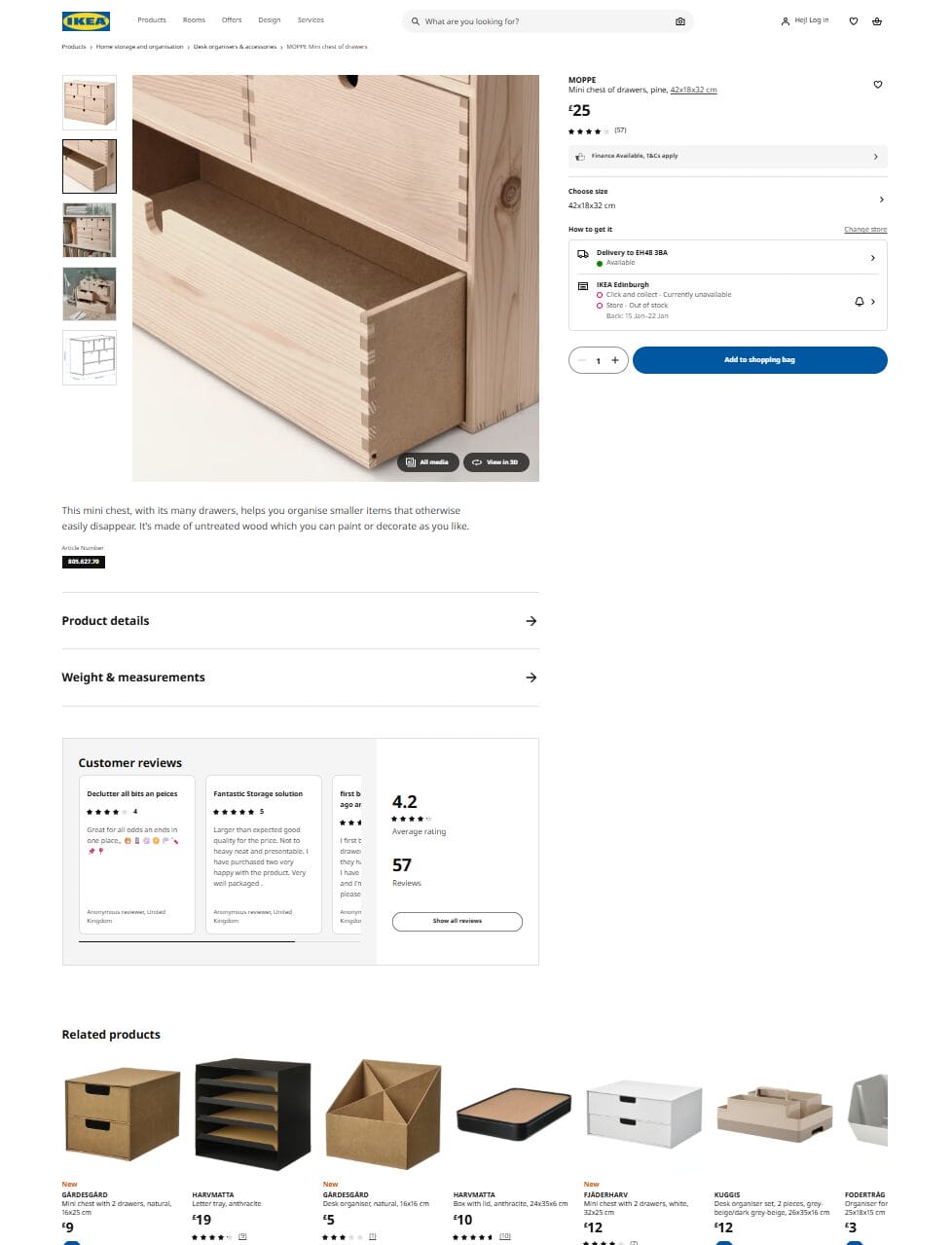
Thin product descriptions are one of the biggest ecommerce SEO mistakes. And luckily, one of the easiest to correct.
Every product page should include:
- A unique description
- Natural keyword usage
- Clear benefits, not just features (updating for seasons and trends is a great way to keep your products relevant in search)
- A longer description where helpful
- Customer reviews
You can also include: delivery and returns information, care instructions, sizing guidance and FAQs.
This content helps with SEO, but more importantly, it builds confidence. People do not just buy products, they buy reassurance.
Unsurprisingly, companies like IKEA have strong product page SEO.
Internal Linking for Ecommerce SEO
Internal linking helps search engines discover pages and helps users find relevant products.
Effective internal linking strategies include:
- “You might also like” sections
- Related products
- “Buy the look” or styled sets
- Links from blog content to products
These links distribute authority around your site and increase average order value by encouraging exploration.
Internal links help Google understand your site and helps keep the customer on for longer.
Schema Markup and Rich Results
Schema markup helps search engines understand your content in more detail and can unlock rich results in search.
For ecommerce, this often includes:
- Product schema
- Price
- Availability
- Reviews and ratings
These enhanced listings, sometimes called rich snippets, can significantly improve visibility and click-through rates. Tools like schema checkers can help you validate your markup. Platforms such as Shopify also provide guidance on implementing ecommerce schema correctly.
If you want to explore this further, this Shopify guide on ecommerce schema is a useful starting point.
Plus, Google’s guidance on schema markup here.
Content Marketing for Ecommerce
SEO for ecommerce doesn’t stop at product pages. Content marketing supports every stage of the customer journey, from discovery to purchase and beyond.
Benefits include:
- Building brand awareness
- Attracting backlinks
- Answering customer questions
- Creating long term, evergreen traffic
Content ideas include:
- How-to guides
- Styling ideas
- Buying guides
- Seasonal content
- Customer stories and reviews
This is also where platforms like Pinterest shine. Pinterest trends, search suggestions, and saved content give valuable insight into what people are planning, not just what they are buying today. See Pinterest Trends for content ideas here.
Repurposing content across platforms increases reach and extends the lifespan of your work.
Repurposing content across platforms increases reach and extends the lifespan of your work.
Examples of Businesses Using Content Marketing
Here’s a few examples of brands using content marketing to promote what they offer:

Technical SEO and Trust Factors you Shouldn’t Ignore
Even the best content will struggle if your site has technical issues.
Key technical SEO essentials include:
- HTTPS for security
- A mobile-friendly design
- Submitting your sitemap to Google Search Console
- Fast page load speeds
- Fixing broken links
Trust signals are equally important for ecommerce success:
- Clear returns and delivery information
- Visible payment options
- Genuine reviews
- Contact details and customer support information
Don’t underestimate the impact of these details. They reduce friction and help people feel safe buying from you.
Measuring What Really Matters
SEO is not just about traffic, it’s about the right traffic.
For ecommerce, you want to track:
- Organic revenue
- Product and category page performance
- Search queries that lead to sales
- Assisted conversions from blog content
A Note on Dark Traffic
Some traffic will be “dark traffic”, meaning it is difficult to attribute directly. Platforms like Shopify, Google Analytics and so on often put this unattributable traffic in ‘direct’. When in actuality the traffic (and conversions) are coming from places like Pinterest, Facebook, Instagram etc.
As you can see from the link (see the image) it originated from Facebook (that’s their tracking ID) but Google Analytics has put it into direct. Unfortunately, it’s not always as easy to detect as this. But this is a good example to show you that this happens, and it happens a lot.

Why Does Dark Traffic Happen?
The referral link gets stripped away so Google Analytics etc is unable to detect where the click came from. This can be due to a variety of reasons like links being sent through Whatsapp, Wifi dropping out, ad blockers, privacy settings and so on.
It’s increasingly difficult to attribute where traffic is coming from, especially with the idea of zero-click searches- where the question is answered on Google- more about zero click marketing here.
It’s so important to know where your customers are coming from. You’ll probably find that it is a variety of places rather than a straight path to purchase. This is why it’s good to be where your customers are and distribute your content more widely.
Don’t Forget Your Google Business Profile (GBP)
Even if you don’t have a physical shopfront, a Google Business Profile is a powerful (and free) tool for ecommerce. It’s essentially a secondary homepage that appears when people search for your brand. By verifying your business, you can show up in Google Maps and local search results, which are often less crowded than the main organic listings.
Filling out your profile helps build that all-important trust. It allows you to showcase your best reviews, answer frequently asked questions, and even post “updates” about new product launches or seasonal offers. Think of it as another way to “own” the search results page when someone is looking for exactly what you do. I talk more about Local SEO for small businesses here.
See more about Google Business Profile here.
The Round-Up
Ecommerce SEO is a long game, but it is one of the most reliable ways to grow an online shop without relying entirely on ads or social media.
When done well, it brings together:
- Strong keyword research
- Clear site structure
- Helpful, human content
- Technical best practice
- Trust and credibility
The goal is not to game search engines. It’s to create a website that is easy to find, easy to use, and easy to trust. One that attracts and converts your potential customers.